
Criminal Cases in the Travis County Courts
Travis County criminal court cases split by offense level. Criminal district courts hear felonies, and the Travis County District Clerk keeps those files. County Courts at Law hear Class A and Class B misdemeanors, whose records belong to the County Clerk. Fine-only Class C cases usually begin in a municipal or Justice of the Peace court. A Class C appeal can later reach the County Clerk, but that does not place every city citation in the county misdemeanor search.
The Blackwell-Thurman Criminal Justice Center at 509 West 10th Street houses the criminal district and county courts. It is a court destination, not the custodian of every related record. The arresting agency still keeps its report, while the clerk keeps pleadings and judgments. Readers tracing the event before charges were filed can consult the separate Travis County arrest history route.
The prosecutor also changes with the charge. The Travis County District Attorney handles felonies, while the County Attorney generally handles Class A and B misdemeanors. That division helps explain why an indictment, information, and police allegation may use different wording. The filed charging instrument is the court record to read when the question concerns what the state chose to prosecute.
Travis County Felony Records Since 2008
The District Clerk case-information page is the main public route for felony files, with public digital criminal coverage from 2008 forward. Search by defendant name or cause number. The Register of Actions can still identify a filing or event when no public document image appears.
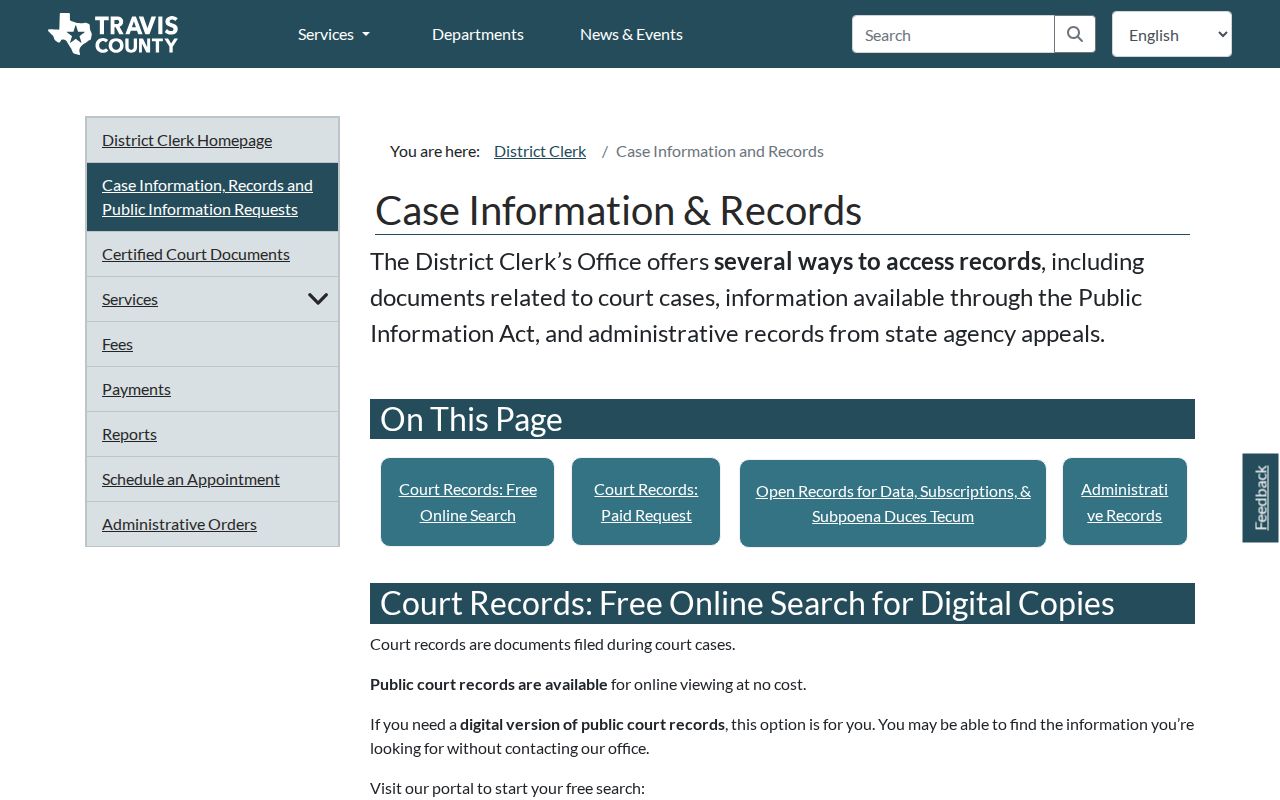
This view is most useful for finding the cause number, assigned court, event trail, and final entry before asking for a copy.
A cause number is a better key than a name once it has been found. Names can vary, and two people can share one. Save the number with the court and filing year. Those three facts make a later call for a Travis County certified record much more precise.
How to Search Case Records
Start with the level of court rather than a broad name query. The felony, misdemeanor, JP, and setting systems answer different questions. Use a full cause number when known, then compare the court, filing date, charge, and party details before treating a result as the right Travis County case.
- Choose the District Clerk for a felony, County Clerk for a Class A or B misdemeanor, or JP portal for a justice court matter.
- Search by cause number or party name. Add a date range or case category when the portal offers it.
- Open the Register of Actions or result record and confirm the assigned court, charge, and filing date.
- Read event entries through the disposition and judgment. Do not treat a scheduled setting as an outcome.
- Call or send the proper clerk request when a file is older, a PDF is absent, or a certified copy is needed.
| Official portal | Search fields | Scope and notes |
|---|---|---|
| District Clerk | Party name, cause number, category, date range | Felony public images generally cover 2008 to present |
| County Clerk | Name or case number | Class A/B misdemeanors and appealed Class C cases |
| Criminal settings | Defendant, attorney, judge/court, case number | Shows settings, not final outcomes |
| JP Odyssey | Record type, name, case criteria, calendar | Free Justice of the Peace scope |
| re:SearchTX | Registered statewide search controls | Coverage and document access vary by court |
The statewide re:SearchTX service is another official route, but participating-court coverage and document access vary. Use the Travis County clerk systems first when the county and court level are known, then use the statewide service as a cross-check.
Travis County Misdemeanor Search Limits
The County Clerk misdemeanor page offers a basic electronic search for one name at no charge, with copy costs added when records are ordered. Its scope is easy to misread. It covers Class A and B misdemeanor matters plus Class C appeals, not every Class C charge filed in Travis County.
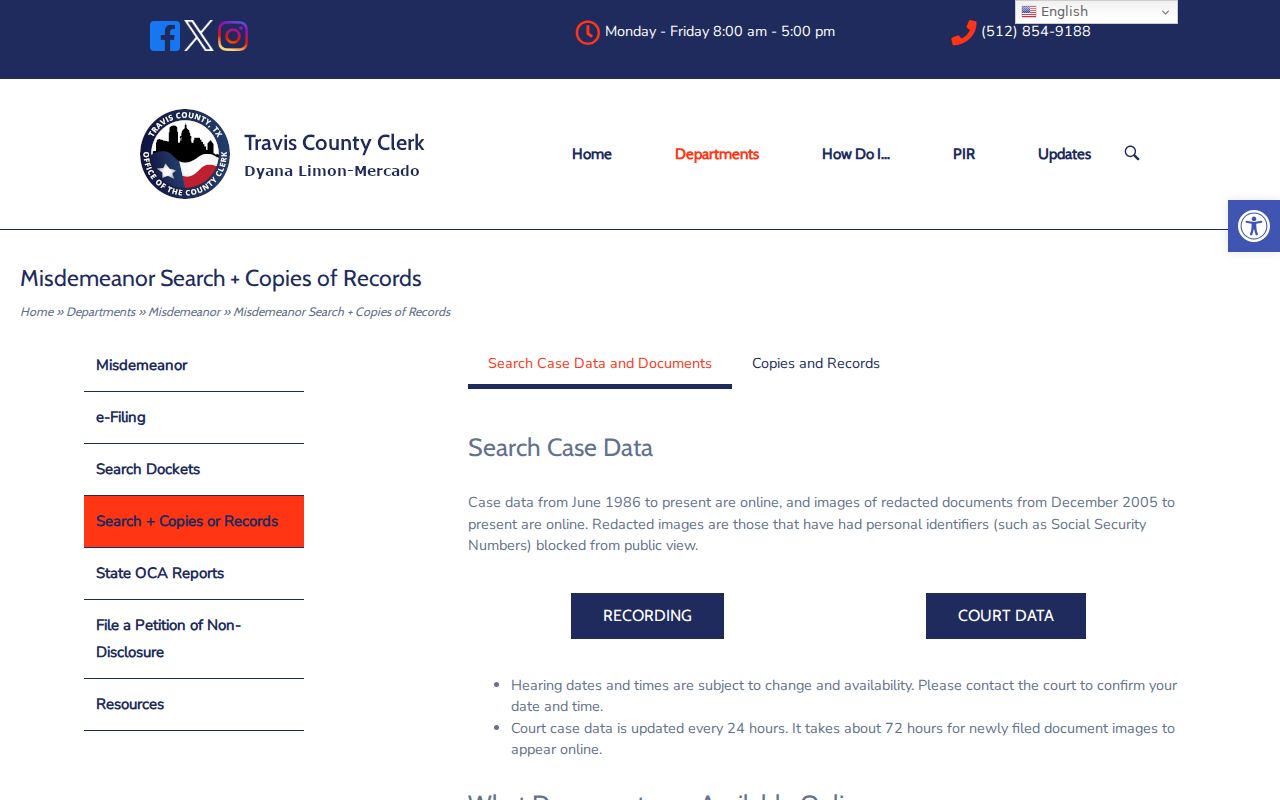
A city citation should first be checked with the issuing municipal court. This split keeps a no-result response from being mistaken for proof that no case exists.
For copies or help with a county misdemeanor file, the County Clerk criminal routing number is 512-854-9188. Felony questions instead go to District Clerk Criminal Records at 512-854-9420.
What the Case File Shows
A Travis County court file tracks the prosecution after a charge reaches court. It may contain the charging paper, appearances, motions, hearings, orders, and the final result. Public screens leave out protected identifiers and may show an entry without its document image.
| Case number and court | The cause number, assigned court, filing date, case type, and current status. |
|---|---|
| Charging document | A complaint, misdemeanor information, or felony indictment, with charge, statute, degree, and count. |
| Docket entries | Appearances, motions, hearings, plea or trial events, and later revocation or adjudication activity. |
| Hearing dates | Past and future settings, which must be distinguished from a disposition. |
| Disposition and judgment | Dismissal, acquittal, plea, conviction, judgment, and related orders when public. |
| Sentence and conditions | Confinement, community supervision, fines, costs, restitution, and concurrent or consecutive terms if entered. |
Bond, warrant, and capias entries may also appear. A capias is a court order directing arrest, often after a filing or missed appearance. It is not the same as the judgment. Offense labels and punishment classes come from Texas Penal Code Chapter 12, but the class or degree still does not reveal the case outcome.
Travis County Criminal Record Desk
The District Clerk Criminal Division maintains adult felony cases, felony search warrants, felony nondisclosure matters, and all Travis County expunction proceedings. That last point matters because even misdemeanor expunction filings route through the District Clerk rather than the clerk that held the original misdemeanor case.
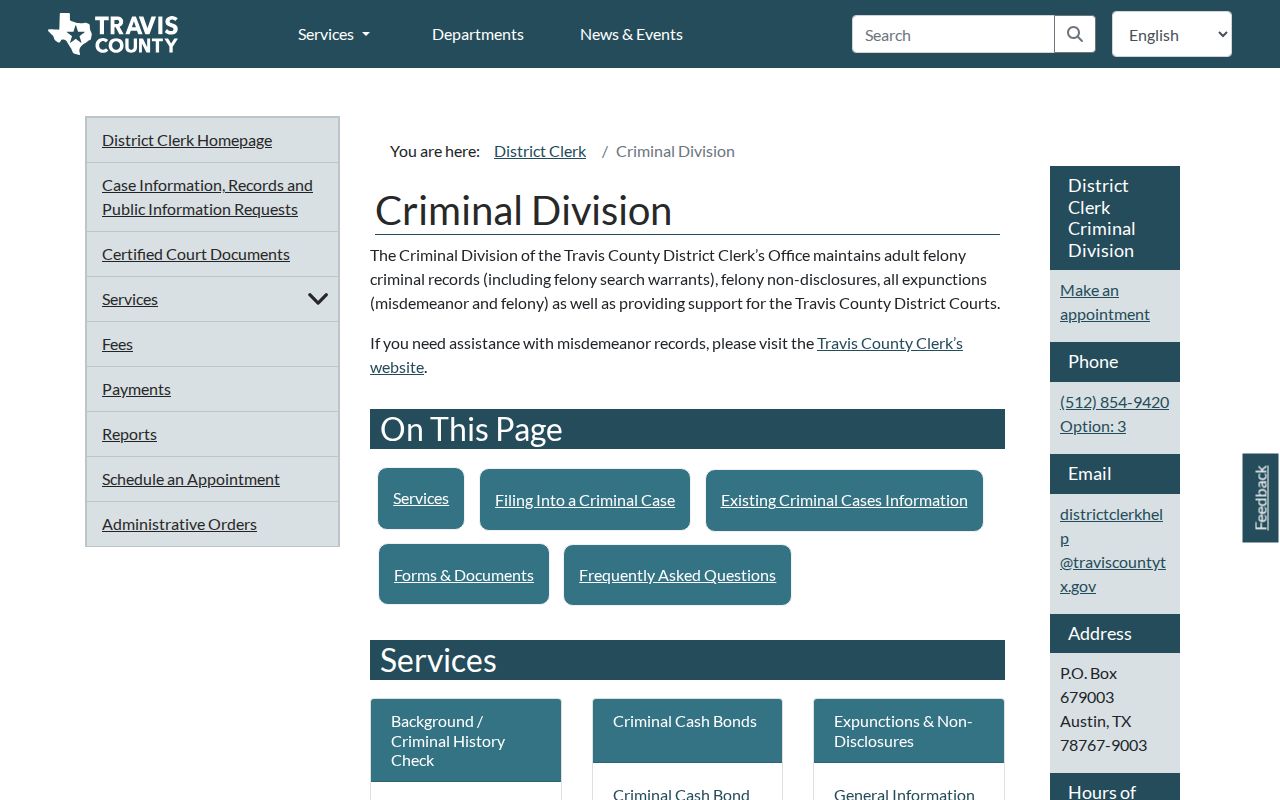
The official division page identifies the correct custodian when a public case screen cannot supply the needed file.
District Clerk Criminal Records
Blackwell-Thurman Criminal Justice Center
509 W. 10th St.
Austin, TX 78701
512-854-9420
Stages of a Criminal Case
A Travis County case may start with an arrest or summons, followed by prompt magistration, bail and counsel warnings, and prosecutor review. A misdemeanor is usually charged by information. A felony may proceed through a grand jury indictment. The Travis County District Attorney prosecutes felonies, while the County Attorney handles Class A and B misdemeanors. The defense then answers the accusation at arraignment, and the case moves through discovery, motions, and pretrial settings.
Case flow: Charges Filed › Arraignment › Pretrial › Plea or Trial › Disposition › Sentencing
A dismissal, plea, acquittal, or trial judgment supplies the outcome. Sentencing may be part of the same event or follow later. An appeal or a motion to revoke community supervision can add a new set of entries without changing the original cause number. The Travis County Public Defender provides its official office contact, but a court appointment is required before contact creates representation.
Travis County Dockets Are Not Outcomes
The county's criminal docket search can locate a setting by defendant, attorney, judge or court number, or case number. It answers when and where a matter is set. It does not establish whether the court dismissed a count, accepted a plea, returned a verdict, or imposed a sentence.
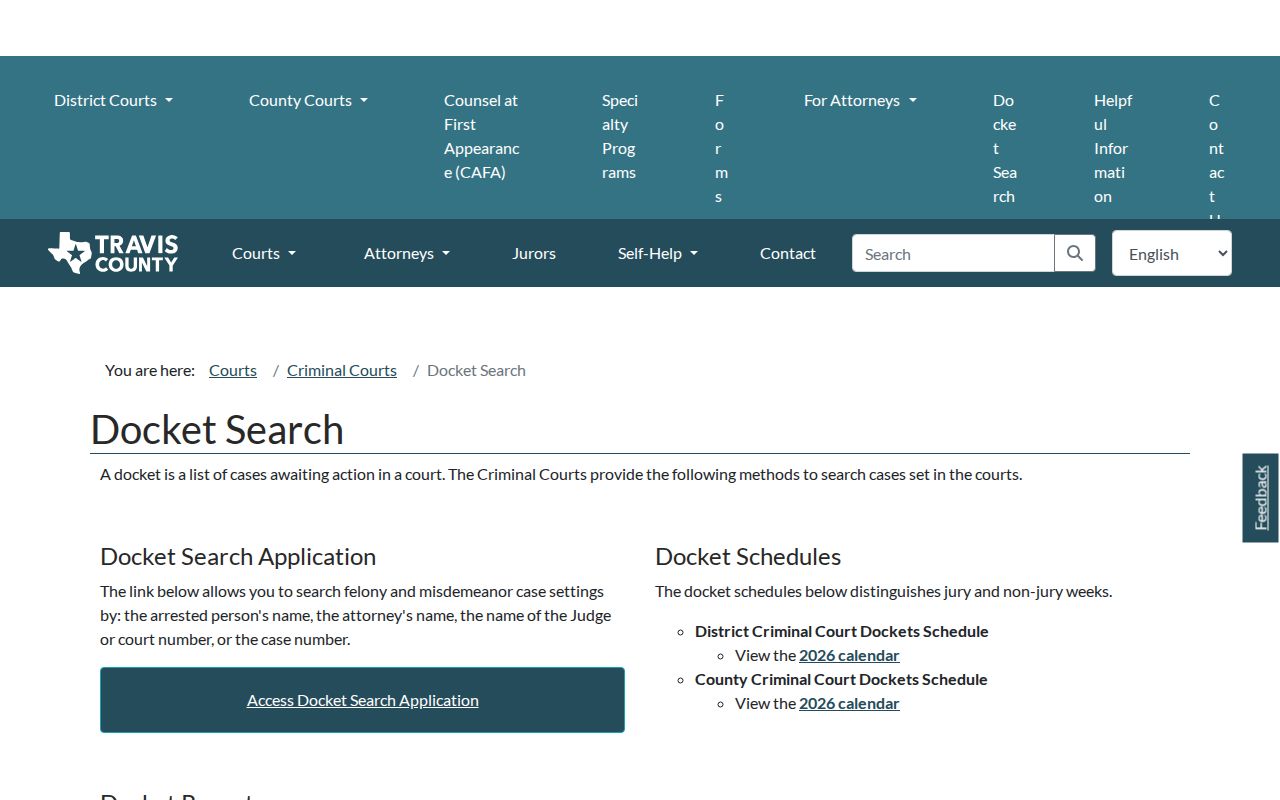
After locating the setting, follow the cause number into the clerk's event register and read through the final disposition or judgment.
Article 15.17 generally calls for magistration without needless delay and within 48 hours after arrest. That early hearing can create a court event, but it is still far from a final ruling on guilt.
Access & Restrictions
Texas court records are broadly open, but public access has limits. Travis County portals may redact Social Security numbers, protected birth details, victim or minor identifiers, and financial-account data. Juvenile files, sealed records, expunged material, and documents covered by a court order may not appear. An entry can remain visible while its PDF is restricted or not digitized.
Ask the clerk that holds the case for older or certified material. Ordinary clerk case files do not route through an unrelated department's Texas Public Information Act form. Judicial administrative records follow Texas Rules of Judicial Administration Rule 12, while executive-agency records follow the Texas Public Information Act. The distinction prevents a request from landing with the wrong office.
When a Travis County criminal case is absent online, give the clerk the name, likely filing year, court level, and any known cause number. Staff can explain the record channel, though they cannot provide legal advice.
Travis County Justice Court Records
The official JP Odyssey public-access search has separate choices for Criminal Records and Court Calendar. It serves Justice of the Peace matters, not felony or County Court at Law files. Selecting the record type first narrows the search to the proper layer.
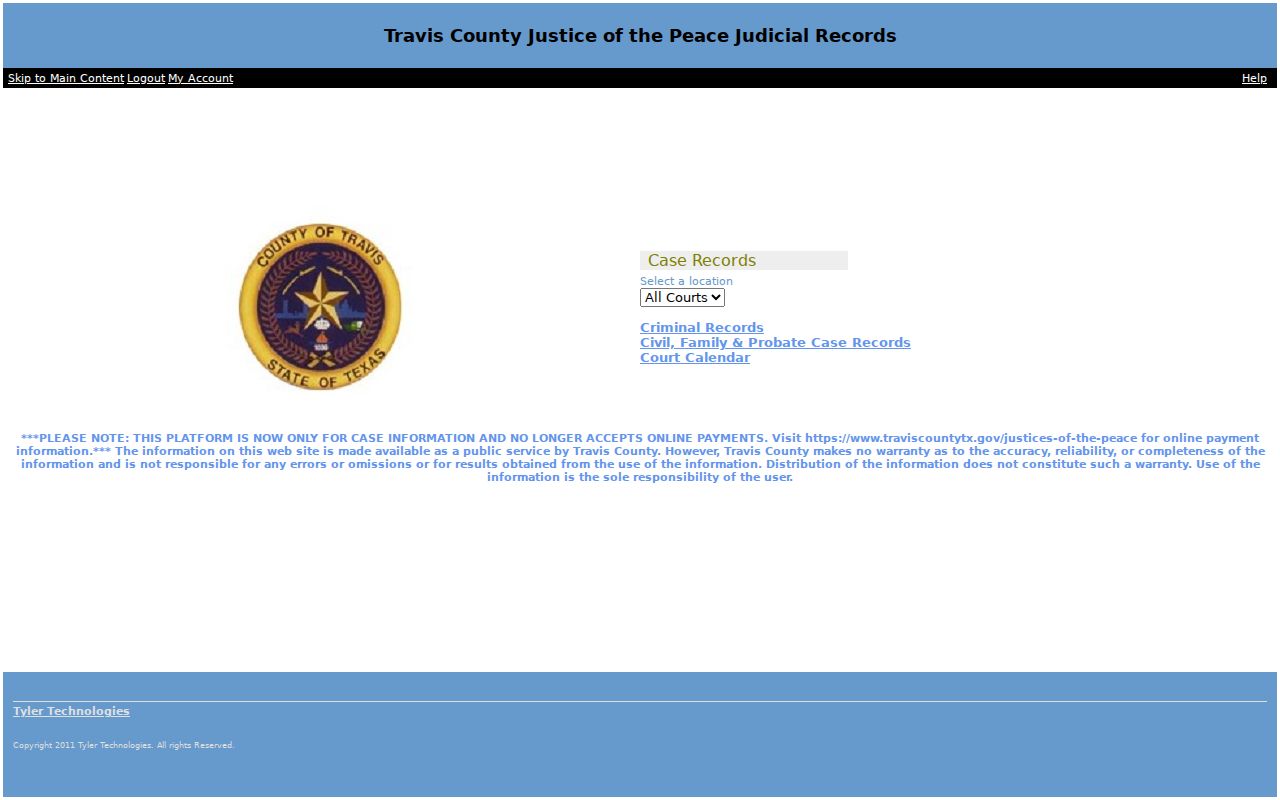
The JP view closes one common gap in a Travis County search, while city municipal records remain with Austin, Pflugerville, Manor, or the other issuing city.
Calendar results deserve the same care as the county criminal setting tool. They show court activity, not the final ruling. Open the case record and locate the last disposition entry, or ask the JP clerk when the public screen does not make the outcome clear.
Federal Cases in Travis County
Federal charges belong to a separate court system. Travis County is in the Austin Division of the U.S. District Court for the Western District of Texas. Federal dockets and documents are searched through PACER after account registration, under the federal fee rules, rather than through either Travis County clerk.
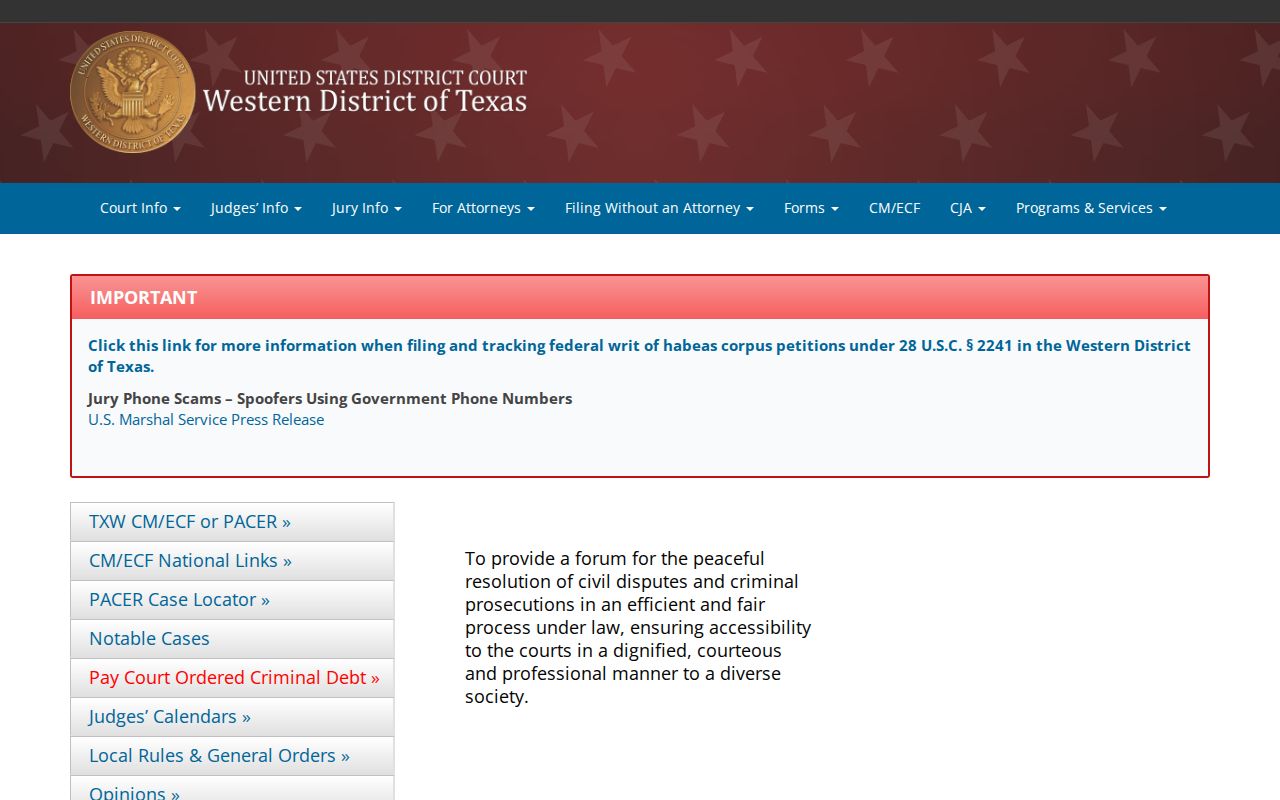
This court image marks the federal boundary: a Travis County name search cannot confirm or rule out a federal prosecution.
Likewise, federal custody may appear through the Bureau of Prisons Inmate Locator rather than TCSO or TDCJ. Always use the sovereign and court named on the charging record.