
How to Check Criminal History in Austin
An Austin record check begins at city level when APD made the report or Municipal Court received the citation. The City Public Records Center handles requests for APD records that are not in the incident database. The municipal portal covers the court's own cases. County and state channels come later, only when custody, higher charges, or statewide history makes them relevant.
- Search APD Incident Reports with a known case number or the geographic fields that fit the event.
- Request the Austin police report through the City Public Records Center when the online incident result is too old, incomplete, or unavailable.
- Search Austin Municipal Court with last name and date of birth, a driver's-license number, or a direct citation or case number where offered.
- For a custodial arrest, check TCSO booking data, then use the County Clerk for Class A or B misdemeanors or District Clerk for felonies.
- Use the Texas DPS public conviction product for reported statewide convictions and deferred adjudications, or fingerprint review for your own identity-linked history.
Each Austin result has limits. An APD narrative records allegations and officer observations. An Austin booking shows custody. An Austin municipal docket shows city-court activity. The statewide DPS product is not a substitute for the local incident report.
Austin Police Reports Cover 18 Months
The free APD Incident Reports database updates daily and covers the period from the current day back 18 months. It can be searched by area command or district, ZIP code, census tract, or a known case number. Those choices make the tool useful even when the searcher knows where an Austin event occurred but lacks a person's full details. Incident search help is available at 512-974-5212.
The official Austin police report search explains the database scope and search routes.
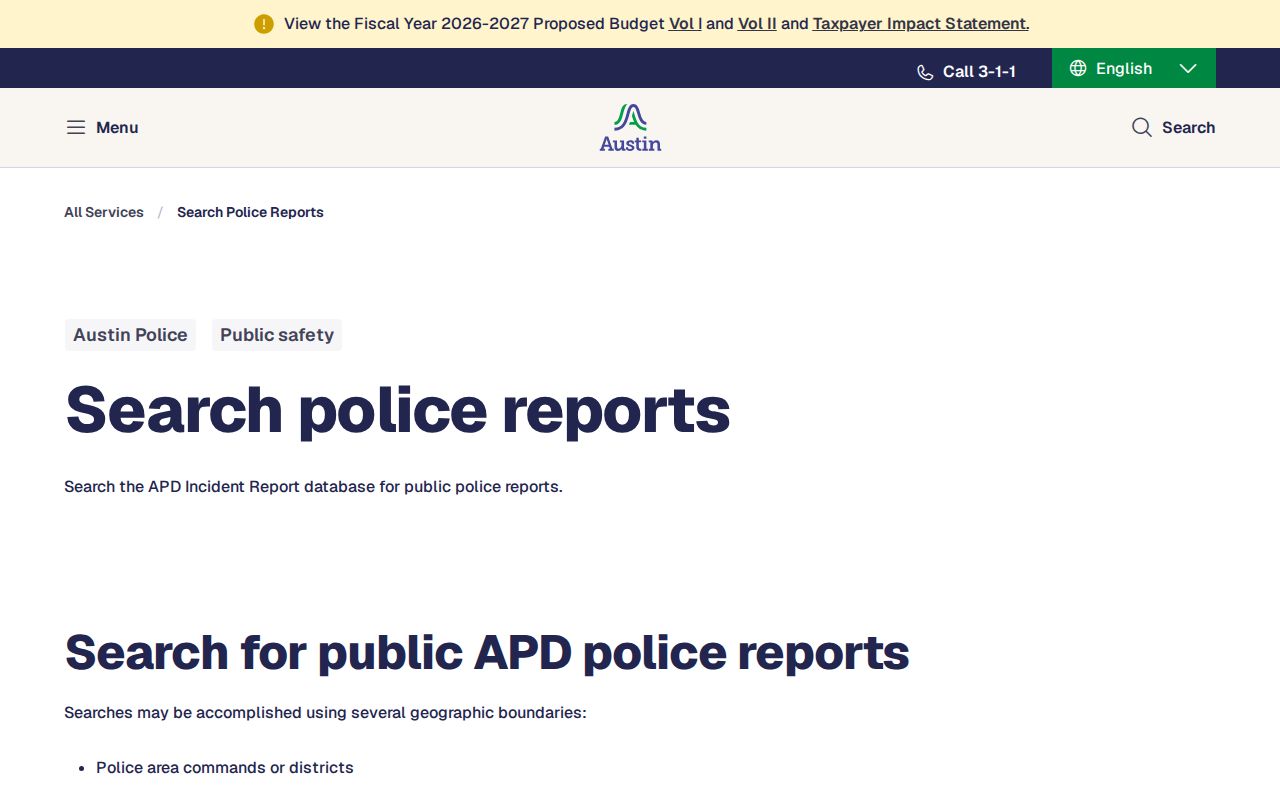
The daily update does not make the database a full Austin criminal history. Records older than the 18-month window, restricted material, and documents beyond the public result must be requested through the city. A report can also exist without a jail booking or filed court case.
The Austin Police Department
APD owns the reports created by its officers. These may include an incident or arrest narrative, CAD material, 911 audio, and body-worn video when releasable. A precise request should name the incident number, date and time, location, involved person, requested record, keywords, and preferred medium. Audio and video requests need enough detail for staff to locate and review the correct file.
The official Austin Police Department page anchors the city's police services and records routes.
Austin's state-capital and university setting means APD is not the only agency that may make an arrest inside the city. DPS Capitol officers, UT Austin Police, constables, and other agencies retain their own reports. Read the agency name on the record before sending a request.
Four Austin Police Request Routes
For APD material outside the public incident database, Austin accepts requests through the online Public Records Center, by email at public.information@austintexas.gov, by mail at P.O. Box 689001, Austin, TX 78768, or by hand delivery. Hand delivery can go to City Hall at 301 West 2nd Street, fourth floor, or APD Headquarters at 715 East 8th Street.
The Austin public information request page sets out these channels and the city's cost rules.
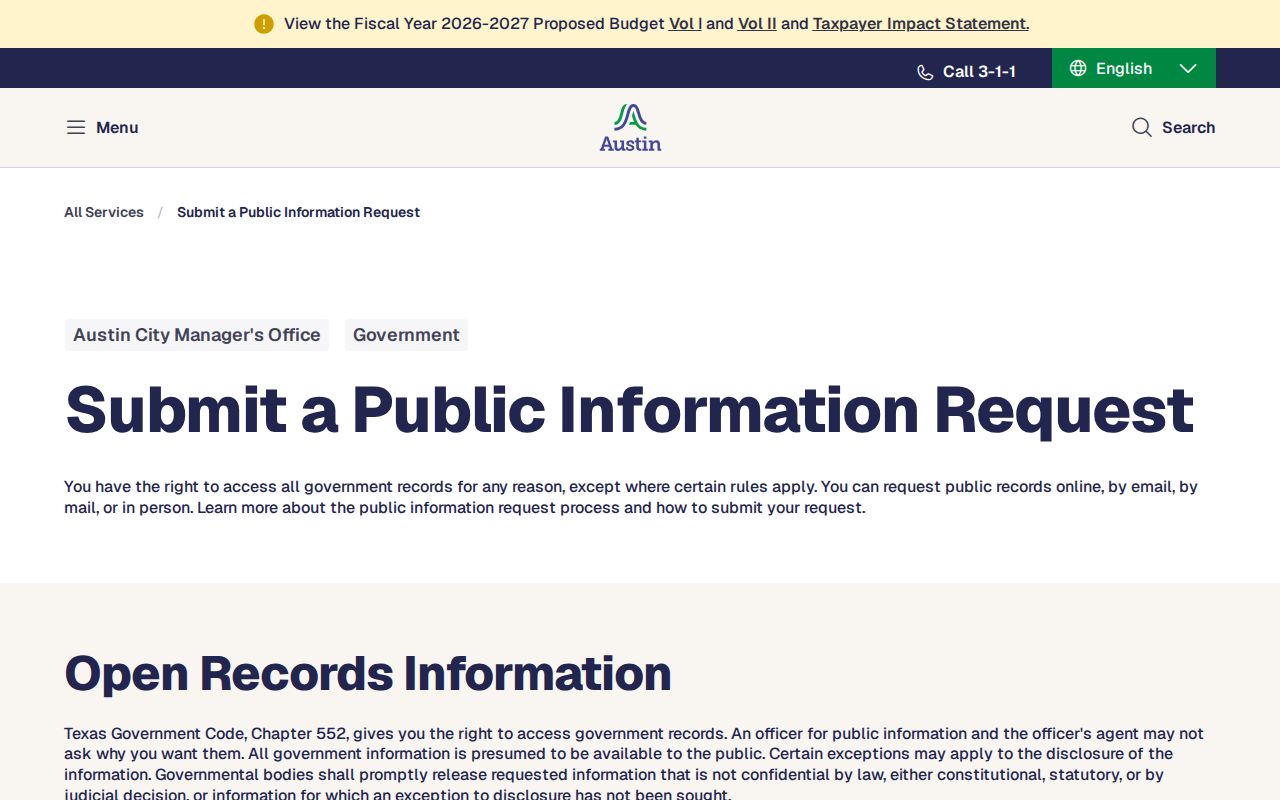
Austin targets release or a status response within ten business days and sends a status update on business day eight. The city may seek clarification when a request is broad. Standard listed charges include $0.10 per paper page, $0.50 per oversized page, $1 for a CD, $3 for a DVD, $45 for offsite retrieval, $15 per hour for allowed labor, $28.50 per hour for programming, and 20 percent overhead on labor or programming. Inspection is often free.
Cost estimate: Austin requires acceptance of an estimate over $40. If the requester does not respond within ten days, the city may close the request.
Arrests and Bookings in Austin
APD arrestees are generally taken into the Travis County Sheriff's Office system. APD keeps the city report number and narrative. TCSO creates the booking number, Jail ID, intake record, charge and bond fields, and custody location. That split is central to an Austin arrest search because neither source replaces the other.
APD incident › TCSO booking › prosecutor review › city or county court file
A person may appear in the TCSO current inmate search before a case is visible at a clerk. Later, the filed charge may differ from the booking allegation. Use the Travis County arrest history channels for current custody and historical incarceration, then return to the city source for the APD narrative.
Austin Warrant Codes and Phone Lines
Austin Court Services routes municipal and community-court warrants to 512-974-4800 or 512-974-4879. Other APD warrant questions go to 512-974-5299 from 8 a.m. to 5:30 p.m. Juvenile arrangements route to Gardner-Betts at 512-854-7090. Municipal and community court warrant numbers may end in MC or CC, which helps identify the issuing system.
The official APD Court Services page supplies the warrant search and resolution contacts.
Confirm an Austin warrant with the issuing court because online data may lag. Do not confront a person named in a result. Resolution depends on the court and may require an appearance, payment, bond, recall, or surrender. Obtain written confirmation and allow time for systems to update.
Austin Municipal Court Records
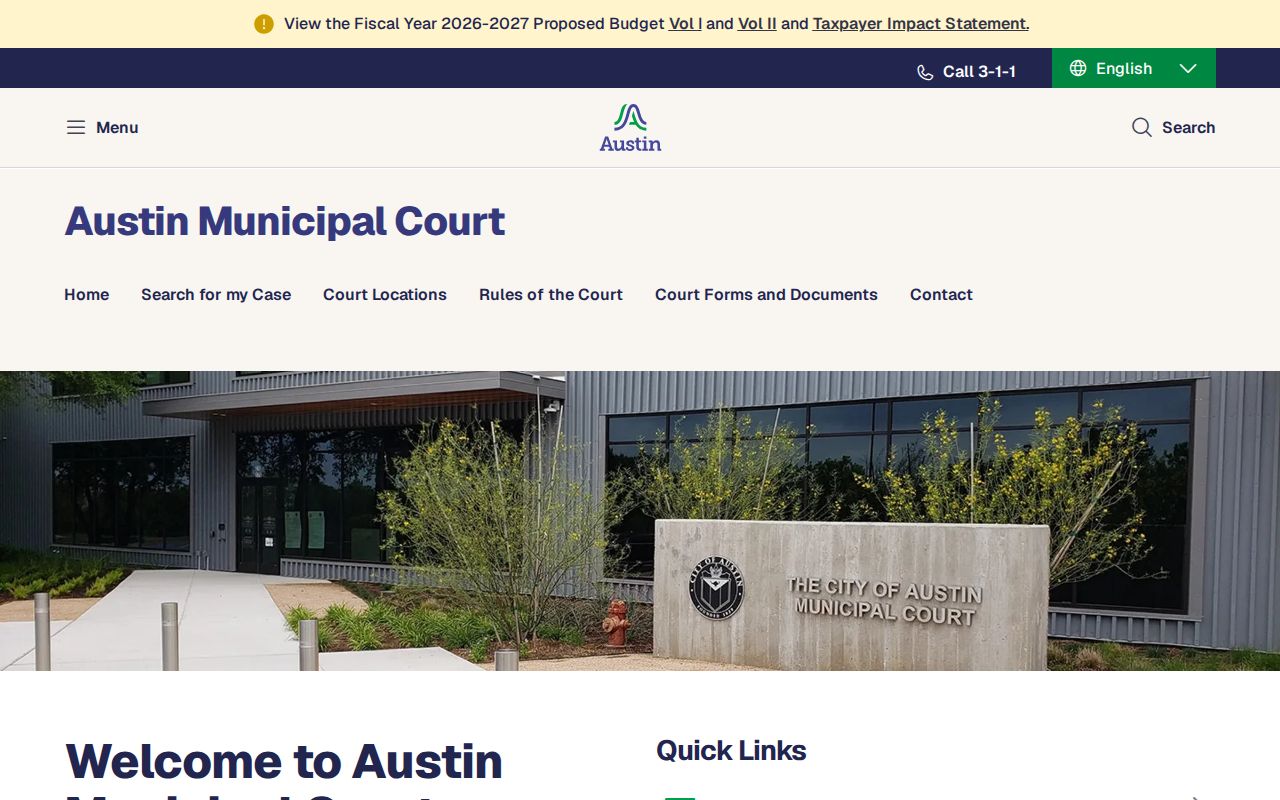
Austin Municipal Court hears traffic cases, city ordinance matters, juvenile cases, disabled-parking cases, and the lowest-level state criminal offenses. Its main courthouse is at 6800 Burleson Road, Building 310, Suite 175, Austin, TX 78744. The North Customer Service Center is at 2121 West Parmer Lane, Suite 116, Austin, TX 78727, open weekdays from 8 a.m. to 4:30 p.m. The general number is 512-974-4800.
The official Austin Municipal Court page identifies the court's locations, jurisdiction, and service routes.
The city court remains the proper source for its original Class C and ordinance cases. A basic Travis County Clerk search does not include every Austin citation. A Class C case enters the County Clerk system only if it is appealed to county level.
| Court Name | Austin Municipal Court |
|---|---|
| Case Types Heard | Traffic, city ordinance, juvenile, disabled-parking, and fine-only state criminal matters. |
| Case Lookup Channel | Online city portal, court service centers, phone, email, or a judicial-record request. |
| What the Portal Offers | Citation review, docket access, payment, hearing requests, and listed deferral or dismissal options. |
| Copies & Records | Use the court's Rule 12 judicial-record request form and state whether certified copies are needed. |
Austin Court Search Fields
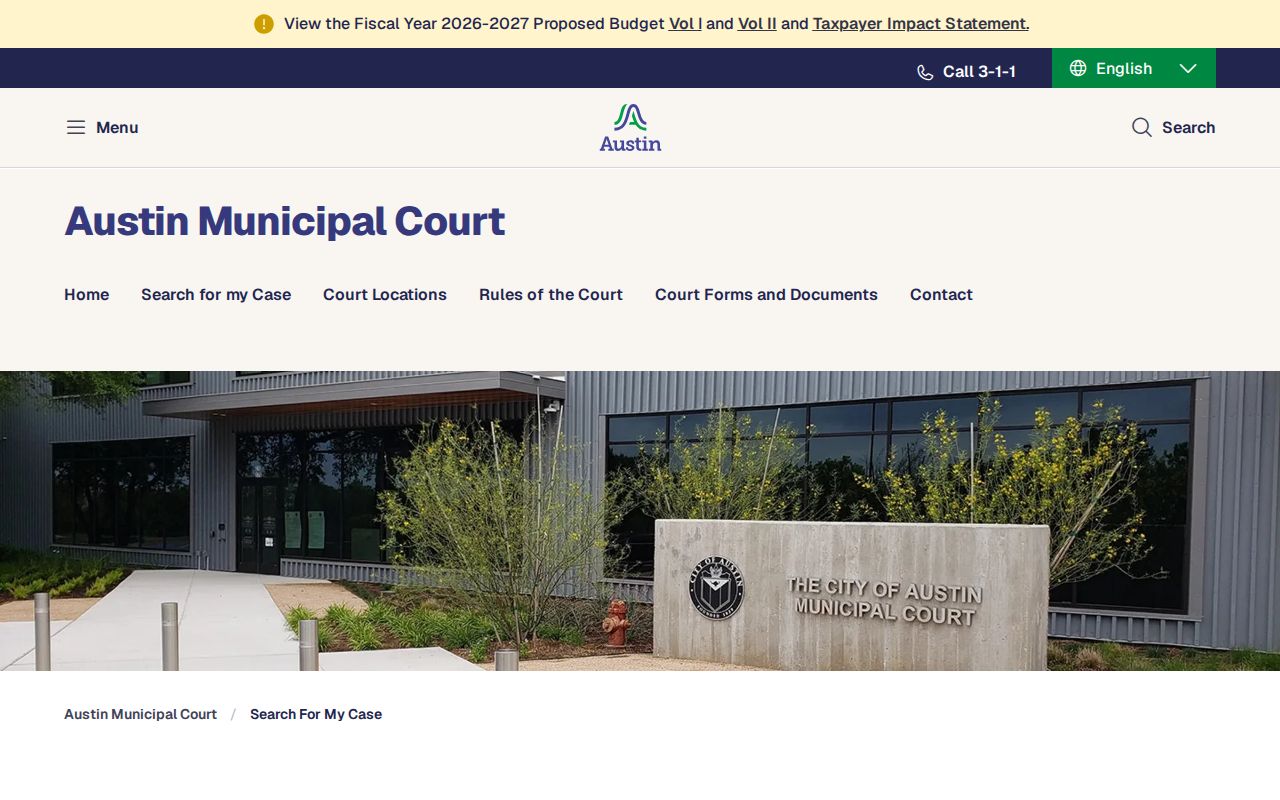
The public Austin Municipal Court lookup uses last name with date of birth or an alternative driver's-license route. A citation or case number is the best direct identifier when known. The judicial-record request form adds requester contact fields and lets the requester state whether certified copies are needed.
The official Austin Municipal Court case search is the entry point for city case lookup.
These identity fields help narrow common names, but they do not broaden the court's jurisdiction. A felony, Class A misdemeanor, or Class B misdemeanor belongs in a Travis County court system even when the arrest occurred inside Austin.
| Field | Type | Use |
|---|---|---|
| Last Name | Text | Required with date of birth on the public lookup route. |
| Date of Birth | Date | Paired identity field for a name search. |
| Driver's License Number | Text | Alternative search path when the number is known. |
| Citation or Case Number | Text | Direct case identifier where offered. |
| Certified Copies | Yes or No | Choice on the judicial-record request form. |
| Requester Contact | Form fields | Name, address, phone, and email for a Rule 12 request. |
Where Austin Records End Up
City records do not all move to one county file. The APD incident narrative stays with Austin. A custodial intake remains with TCSO. Austin Municipal Court keeps its fine-only city case. A Class A or B misdemeanor filed after an Austin arrest goes to the Travis County Clerk, while a felony goes to the District Clerk. Courts and clerks then report qualifying dispositions into the Texas criminal-history system.
Record flow: Austin Police Department › Travis County Courts › Texas Department of Public Safety
Use that flow as a routing map, not a promise that every source repeats all prior facts. The local report may contain an officer narrative that a booking profile lacks. The court file may show dismissal or judgment that the first APD result does not. For broad county context, the Travis County criminal history overview explains how the custodians fit together.
Austin Class C Records Stay Local
A common search error is treating the Travis County Clerk's misdemeanor result as a complete Austin search. County Clerk records cover Class A and B misdemeanors and Class C appeals. They do not collect every original traffic ticket, ordinance case, or fine-only state charge filed in Austin Municipal Court. A zero county result can therefore coexist with an active Austin case.
Start with the citation itself. Check its issuing court and number, then use last name plus date of birth or driver's-license data in the Austin portal. If the case was appealed, search the County Clerk as a second step. A court setting shows an upcoming event, not a final disposition, so inspect the docket outcome and any judgment or dismissal.
Austin Report Versus County Booking
An APD report documents calls, observations, allegations, evidence, and enforcement actions. A TCSO booking record documents intake, identity, custody site, charges entered at booking, bond, holds, and release. A Municipal Court or county clerk file documents what was actually filed and what the court did. Comparing the three prevents a city police allegation from being mistaken for a final outcome.
- Incident number
- The APD identifier used to locate the city police event and related request.
- Booking number
- The TCSO identifier for one county jail intake event.
- Jail ID
- A local TCSO person identifier used across custody records.
- Cause number
- The number assigned after a charge enters a court file.
Keep all four identifiers when tracing an Austin arrest. Similar names and changing charges make number-based matching far safer than assuming that separate results describe the same person or event.
Public Access Rules
Austin executive records, including releasable APD material, generally route under the Texas Public Information Act. The city may redact or withhold active-investigation material, juvenile information, victim-sensitive data, medical data, protected addresses, and personal identifiers when law permits or requires it. Austin Municipal Court case files and judicial administrative records follow court-record rules, including Texas Rule of Judicial Administration 12 for the latter category.
Key Statutes:
Texas Government Code Chapter 552 makes public information available unless an exception or confidentiality rule applies and requires a prompt response.
Texas Government Code Chapter 411 controls criminal-history dissemination and the public DPS conviction product.
Texas Rule of Judicial Administration 12 governs judicial-record requests, which differ from ordinary city executive records.
A requester need not explain a purpose but must reasonably describe an existing record. The city is not required to answer research questions or create a new record. Ask the office that holds the source, use enough detail to locate it, and verify any name match with dates and record numbers.